What Is a Web Browser and How Does It Work?
What is a web browser? Learn how browsers work, explore popular examples like Chrome and Safari, and get tips for safer, more private browsing.


Last updated Oct 22, 2026
All About Cookies is an independent, advertising-supported website. Some of the offers that appear on this site are from third-party advertisers from which All About Cookies receives compensation. This compensation may impact how and where products appear on this site (including, for example, the order in which they appear).
All About Cookies does not include all financial or credit offers that might be available to consumers nor do we include all companies or all available products. Information is accurate as of the publishing date and has not been provided or endorsed by the advertiser.
The All About Cookies editorial team strives to provide accurate, in-depth information and reviews to help you, our reader, make online privacy decisions with confidence. Here's what you can expect from us:
A web browser is the app you use on your phone, computer, or tablet to access sites on the internet. Without these software programs, you can't watch YouTube, send emails, or shop online without downloading another app.
The most common browsers include Google Chrome, Apple Safari, Microsoft Edge, and Mozilla Firefox. But dozens more exist, and each one provides different features and levels of privacy.
Keep reading to find out how web browsers work, what makes popular browsers different, and how to make your browsing experience more private and secure.
Web browsers act like translators, taking the code that creates web pages and turning it into the images, text, and videos you see on your screen. They use protocols such as HTTP and HTTPS to request and receive information from websites, then use a rendering engine to display that information.
In short, a browser is the program that lets you view and interact with websites without needing to read the code behind them. This means you don’t need to understand hypertext markup language (HTML), JavaScript, or other code to navigate the internet. For example, here’s the HTML code for this page:

And here's the view we see when our browser loads the page:

When you type a web page address or uniform resource locator (URL) — such as www.allaboutcookies.org — into your browser or click on a link, you’re giving your browser directions for where you want to go.
Once it knows your destination, your browser sends a request to the server or servers where the web page’s content is stored, then retrieves that content and displays it to you. In other words, you're actually making a list of requests to retrieve content from various resource directories or servers where that page's content is stored.
The web page you requested to see may be made up of content from different sources. Images may come from one server, text content from another, scripts from a third server, and ads from a different server.
Your browser then retrieves the data from each server and uses rendering engine software to translate the web page’s HTML and other code into images and text.
Not sure what browser you're using right now? The information below can help identify your browser and connection:
The browser identification information is called a user-agent string. It may contain your browser name, operating system, and version information, although some browsers limit or modify these details for privacy. If you're unsure which browser you're using, you can also check its About section in the settings menu.
If you'd rather use a different browser, our guide explains how to change your default browser on your device.
Web browsers have several important controls that help you navigate websites and manage your browsing experience. The numbers below correspond to the features labeled in our infographic:
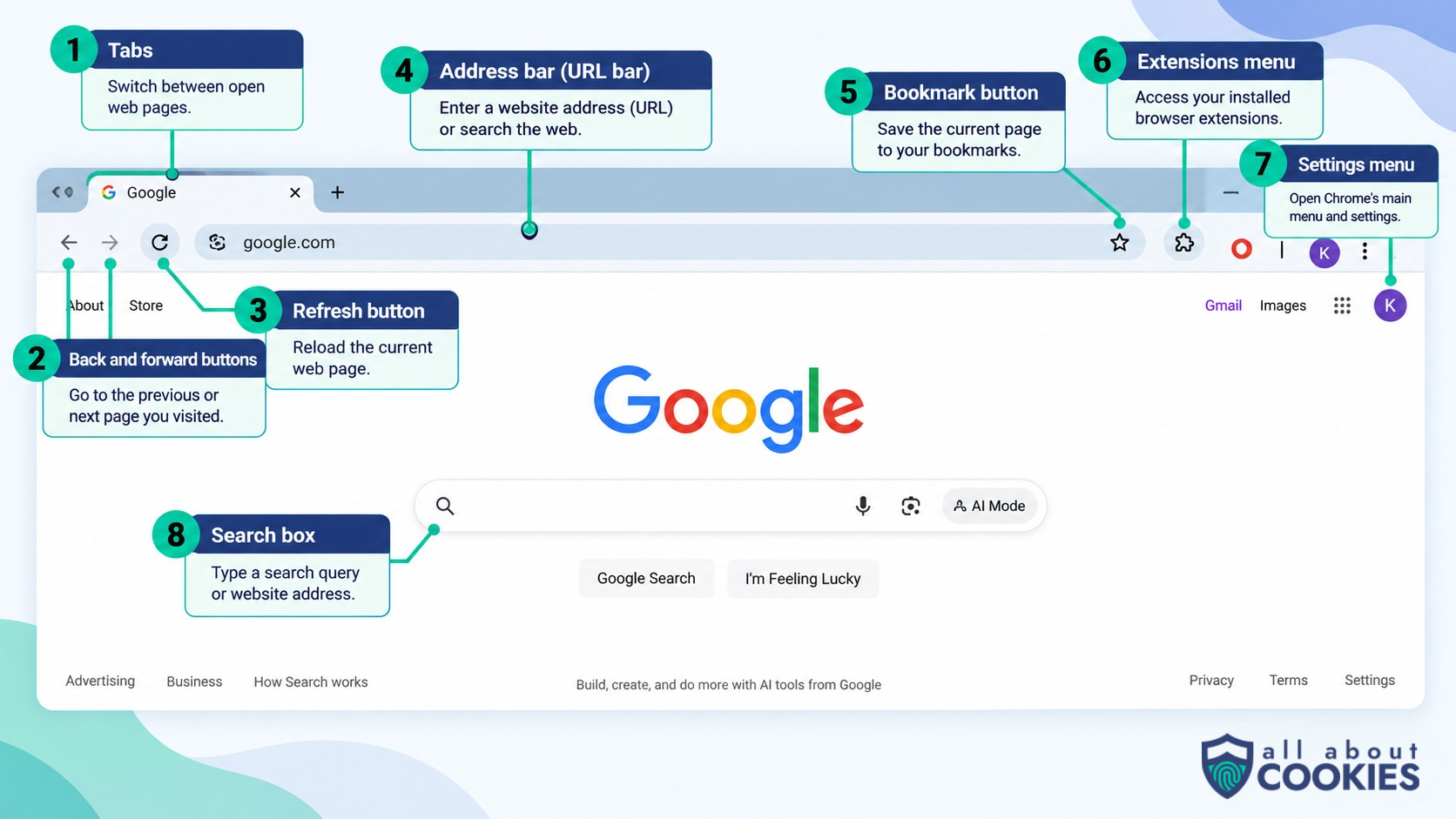
Not every browser feature is visible in the infographic. Here are a few others worth knowing about:
There are plenty of browser options, and most are fairly similar. However, some are open-source software, while others offer additional features that you might like.
Here's a quick comparison of some popular web browsers and what makes them different:
| Web browser | Available on | What makes it different |
| Google Chrome | Windows, Mac, Linux, Android, iOS | Syncs with Google accounts and supports a wide range of extensions |
| Apple Safari | Mac, iPhone, iPad | Built into Apple devices with integrated privacy features |
| Microsoft Edge | Windows, Mac, Linux, Android, iOS | Integrates Microsoft services and Copilot AI features |
| Mozilla Firefox | Windows, Mac, Linux, Android, iOS | Offers customizable privacy settings and enhanced tracking protection |
| Brave | Windows, Mac, Linux, Android, iOS | Blocks many ads and trackers by default |
| Opera | Windows, Mac, Linux, Android, iOS | Includes built-in ad blocking and additional privacy tools |
| Tor Browser | Windows, Mac, Linux, Android | Routes traffic through the Tor network to help protect your anonymity |
Here's a closer look at some of these browsers and their features:
If privacy is your biggest priority, check out our guide to the most secure browsers for a closer comparison of their security features.
A web browser and a search engine aren't the same thing, although you often use them together. A browser is the software that opens and displays websites, while a search engine helps you find websites and information online.
| Web browser | Search engine |
| Software used to open and interact with websites | A service that helps you find websites and information |
| Examples include Chrome, Safari, Edge, and Firefox | Examples include Google Search, Bing, and DuckDuckGo |
| Installed on or available through your device | Usually accessed through a web browser |
For example, you might open Google Chrome and use Google Search to look for a recipe. Chrome is the browser displaying the results, while Google Search is the search engine finding them. You can also use a different search engine, such as Bing or DuckDuckGo, within Chrome.
One of the biggest shifts in browsers recently is the rise of artificial intelligence (AI). Many major browsers now include AI assistants that can summarize a page, answer questions about what you’re reading, and help you find information. A newer category, often called “agentic” or AI browsers, goes further, completing multi-step tasks for you such as researching a topic, filling out forms, or comparing products while shopping.
These features are convenient, but the use of AI agents raise privacy risks. An AI assistant that can access your tabs, emails, or calendar may be able to process sensitive personal information. Before using these tools, review what data they can access, what permissions you've granted, and how your information may be stored or used.
A VPN can help protect your internet connection, but it won't prevent an AI assistant from accessing information you've authorized it to use.
HTTP and HTTPS are protocols that browsers use to communicate with websites. HTTP stands for Hypertext Transfer Protocol, while HTTPS stands for Hypertext Transfer Protocol Secure.
The key difference is encryption. HTTPS uses transport layer security (TLS) to encrypt information transmitted between your browser and the website's server. This helps protect information such as passwords and payment details from being intercepted or modified while in transit.
Most modern browsers show connection security information near the address bar. However, HTTPS doesn't automatically mean a website is trustworthy. Scam and phishing websites can also use encrypted connections.
Even with growing privacy concerns, 1 in 4 users admit they accept cookies automatically — without checking what data they’re agreeing to share.

You can update your browser's privacy settings to control cookies, manage website permissions, and adjust security protections. The exact steps vary depending on your browser and version. Here's how to find the main privacy settings in Google Chrome:
1. Go to the top right of the browser and select the three dots. Then choose Settings from the drop-down menu.

2. Choose Privacy and security. From here, you can select Delete browsing data (or Clear browsing data, depending on your version) to remove browsing history, cookies, and cached files.
Under Third-party cookies, you can review Chrome's controls for limiting cross-site tracking. You can also manage website permissions and other privacy options. Available settings may differ depending on your browser version and Google's current tracking protection features.
Under Security, you can choose the level of Safe Browsing protection Chrome uses against malicious websites and downloads.

You can also use Safety Check to review security-related settings and identify potential issues, such as outdated browser software or compromised passwords.

Chrome and other browsers help you secure your online experience by offering different levels of protection or specific features. Here are the five browser privacy and security tips we recommend most.
If you want additional privacy on a shared device, many browsers offer an incognito or private browsing option. Incognito mode generally doesn't save your browsing history after you close all private windows, and temporary cookies and site data from that session are removed.
However, incognito mode doesn't make you anonymous online. Websites, network administrators, and your internet service provider may still be able to observe aspects of your browsing activity.
On Chrome, you can open an incognito window from the three-dot menu in the top-right corner by selecting New Incognito Window, or by pressing Ctrl + Shift + N (Cmd + Shift + N on a Mac).
You can add another level of privacy by using a virtual private network (VPN). VPN clients establish an encrypted connection between your device and the VPN server, helping protect your internet traffic from people monitoring the local network.
A VPN also replaces the public IP address websites normally see with the VPN server's IP address. Some VPNs include additional features that block malicious websites, ads, or trackers.
However, VPNs don't make you completely anonymous, and they don't replace HTTPS or your browser's built-in security protections. If you're interested in additional privacy features, see our guide to the best VPN services.
The standard search engines are Google, Bing, and Yahoo, but you might prefer to use a private search engine instead.
Private search engines, like DuckDuckGo and Qwant, emphasize limiting the collection or use of personal information for search tracking and advertising. Their specific privacy practices differ, so it's worth reviewing their policies before choosing one.
Some pop-up ads are harmless, but some are created by scammers and designed to trick you into giving up your personal information.
You can block pop-ups and redirects inside your browser settings. Third-party ad blockers such as Total Adblock can provide additional protection by blocking many ads and trackers.


 Top ad blocker that historically scores 100/100 on AdBlock Tester, passing every banner, interstitial, pop-up, and contextual ad test
Successfully blocked YouTube ads in our testing, one of the trickier platforms for ad blockers to handle consistently
Works across Chrome, Edge, Safari, and Opera, plus Android and iOS mobile apps
Removing cookies can help limit stored tracking information and clear website data from your browser. You can also reject optional cookies when websites provide that choice or adjust your browser settings to limit third-party cookies.
Keep in mind that deleting cookies may sign you out of websites, reset your preferences, or remove items saved in shopping carts. You don't need to block every cookie to improve your privacy.
Before the World Wide Web became widely available to the public in the 1990s, the internet was used primarily by researchers, universities, government organizations, and other institutions. Early web pages were mostly text-based and quite simple, as you can see in this replica of the very first web page, which was hosted on Tim Berners-Lee’s (the inventor of the World Wide Web) NeXT computer.
Because web pages started out simple, it makes sense that many of the first web browsers were simple, too. The first browsers had a very specific purpose: to make web page code readable and understandable.
As web developers created more web objects and software libraries, browsers needed to be updated quickly to keep up. Eventually, plug-ins were also developed to extend existing browsers, enabling them to render new types of objects on web pages.
Browsers have changed and continue to change in order to support everything from shopping carts to embedded videos. Private browsers have popped up to address concerns about data privacy and cookie tracking, and the newest browsers now include AI assistants that can read pages and complete tasks for you.
Here’s a list of some of the more well-known browsers and the year they were created:
A web browser is the software that lets you open websites, watch videos, shop online, and interact with content on the internet. Popular browsers like Chrome, Safari, Edge, and Firefox all perform these basic functions, but they differ in their features, device compatibility, and privacy protections.
The best browser for you depends on what you use it for. If convenience and compatibility matter most, a browser that works well with your devices and accounts may be enough. If privacy is a priority, look for features that limit tracking, block unwanted ads, and give you more control over your browsing data.
You can also improve your privacy by reviewing your browser settings and using a secure ad blocker to help reduce unwanted ads and trackers.
A web browser is the app that displays websites, like Chrome, Safari, or Edge. A search engine, like Google or Bing, is a website you use within a browser to find other websites. Think of the browser as the car and the search engine as the map you use to decide where to drive. It's a common mix-up because many browsers open a search engine by default, but they're two separate tools.
AI browsers (like Chrome with Gemini, Edge with Copilot, or Perplexity's Comet) can be useful, but they come with privacy trade-offs. To summarize pages or complete tasks for you, these assistants often need access to your open tabs and sometimes your email or calendar, which means a lot of personal data passes through them. They're generally safe to use, but review the permissions you grant, be cautious about letting an AI act on sensitive accounts, and consider pairing your browser with privacy tools like a VPN.
Google Chrome is the most popular web browser in the world, with roughly 66% of the global market share as of September 2026, according to StatCounter. Apple Safari is a distant second at around 18%, boosted by its default status on iPhones and iPads, followed by Microsoft Edge, Mozilla Firefox, and Opera.
Browsers store cookies that websites use to remember information about your visits. Some cookies keep you signed in, save shopping cart items, or remember preferences. Others help websites measure traffic or track activity for advertising.
You can manage cookies through your browser's privacy settings. Websites may also ask for your consent to use certain cookies, depending on applicable privacy laws. Blocking or deleting cookies can improve privacy, but it may also sign you out of accounts or reset your preferences.
On Windows, click the X in the upper-right corner of your browser window or press Alt + F4. On a Mac, click the red close button or press Command + W to close the current window. On a phone or tablet, you can close individual browser tabs or leave the browser using your device's app controls.
Closing a browser could log you out of a website, but your login session could stay active thanks to session cookies. But session cookies are set to time out or expire after a certain amount of time, so you won’t stay logged in indefinitely.
It’s a good idea to close all your browser windows because that forces all of your online sessions to end or timeout.
Closing your browser window or tabs can also free up system resources becuase multiple open browser tabs can impact your memory and CPU usage. If your browsing experience or computer seems slow, make sure you don’t have multiple browser windows or tabs open.
Closing your browser window is also good practice because you likely use your computer to log into banking and other personal sites. If you get up for a moment and walk away from your device with a tab still open to your bank account, someone could access it and steal your personal information.
Top ad blocker that historically scores 100/100 on AdBlock Tester, passing every banner, interstitial, pop-up, and contextual ad test
Successfully blocked YouTube ads in our testing, one of the trickier platforms for ad blockers to handle consistently
Works across Chrome, Edge, Safari, and Opera, plus Android and iOS mobile apps