Samsung TVs Still Send Tracking Data After Your Opt-Out, Study Finds
Researchers found that Samsung and Vizio smart TVs continued sending tracking-like data even after users opted out, raising fresh concerns about smart TV privacy.
We receive compensation from the products and services mentioned in
this story, but the opinions are the
author's own. Compensation may impact where offers appear. We have not included all available products or offers.
Learn more about
how we make money
and
our editorial policies.
Advertiser Disclosure
All About Cookies is an independent, advertising-supported website. Some of the offers that appear on this
site are from third-party advertisers from which All About Cookies receives compensation. This compensation
may impact how and where products appear on this site (including, for example, the order in which they
appear).
All About Cookies does not include all financial or credit offers that might be available to consumers nor
do
we include all companies or all available products. Information is accurate as of the publishing date and
has
not been provided or endorsed by the advertiser.
Close
Editorial Policy
The All About Cookies editorial team strives to provide accurate, in-depth information and reviews to help
you, our reader, make online privacy decisions with confidence. Here's what you can expect from us:
All About Cookies makes money when you click the links on our site to some of the products and offers that
we mention. These partnerships do not influence our opinions or recommendations. Read more about how we
make money.
Partners are not able to review or request changes to our content except for compliance reasons.
We aim to make sure everything on our site is up-to-date and accurate as of the publishing date, but we
cannot guarantee we haven't missed something. It's your responsibility to double-check all information
before making any decision. If you spot something that looks wrong, please let us know.
Close
Your smart TV knows what you’re watching. It can track content from your cable box, gaming console, antenna, and even videos you mirror from your phone. But most smart TVs let you turn that tracking off. However, a new study suggests that on Samsung and Vizio sets, that switch may not do what it promises.[1]
And on VIDAA OS, researchers found a publicly accessible server containing more than 57 million viewing-detection records linked to over one million TVs, revealing what content was being watched and when.
The risk? TV makers can use your viewing habits to target you with ads, while sharing or selling that data to other companies. In some cases, unencrypted tracking data can also expose what you watch, your device ID, and potentially sensitive interests.
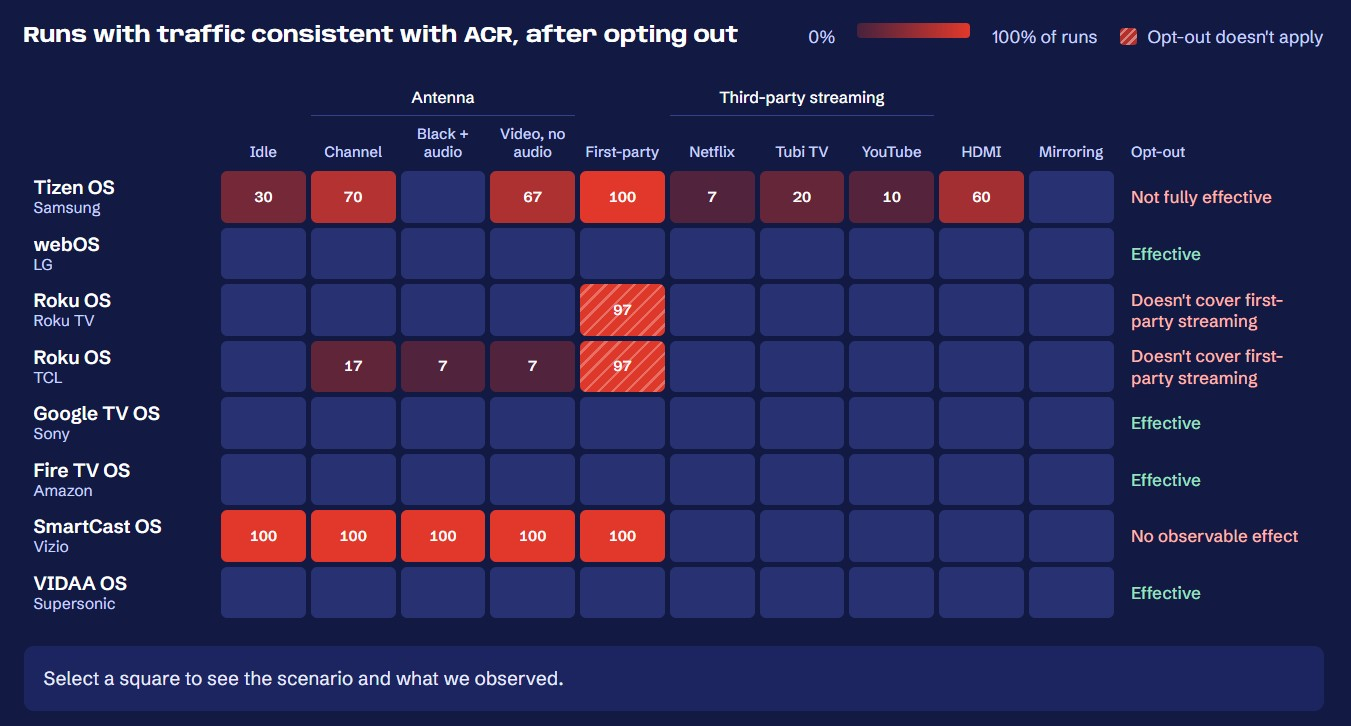
On LG, Sony, Amazon Fire TV, and VIDAA, turning off automatic content recognition (ACR) works. However, on Samsung (Tizen) and Vizio, the TVs kept sending traffic consistent with tracking even after ACR was turned off.
ACR takes a small fingerprint of what's on your screen, which might be an audio snippet or a sample of the picture, and sends it to a company server. The server matches it against a library of shows and ads, the same way Shazam identifies a song. This results in a record of what you watched, and companies use it for audience measurement and targeted ads.
ACR is built into the TV's operating system, so it can monitor content from almost any source, be it an antenna, cable box, or gaming console plugged in via HDMI, a built-in streaming app, or even your phone's screen when you're mirroring it to your TV.
Watching the Watchers
The researchers tested 12 TVs from 10 brands, covering eight TV operating systems that run about 95% of U.S. smart TVs. They ran 5,943 automated experiments, repeating each test 30 times with ACR on and 30 times with ACR off.
Samsung, which accounts for about 34% of U.S. smart TVs, continued to send traffic consistent with ACR even after it was turned off. The data was sent in all 30 of Samsung's own streaming service tests, 41 of 60 antenna tests, 18 of 30 HDMI tests, and six of 30 Tubi tests.
Vizio, which accounts for about 11% of the U.S. market, sent traffic to a server the researchers linked to ACR even after users opted out. The traffic was even sent when the TV was just sitting idle.
Turning ACR off doesn't stop tracking within Roku's own streaming service, The Roku Channel, either. Roku discloses this in its terms, and TCL-made Roku TVs mention it in the settings menu, but Roku-branded TVs don't.
However, one potential relief is that the traffic sent by Samsung and Vizio TVs, even after turning off ACR, is encrypted. This means researchers couldn’t confirm what data the TVs were actually sending. They described the traffic as suspicious and said it might indicate potential privacy violations.
But VIDAA's ACR traffic isn't encrypted at all. This means anyone positioned between the TV and the server, such as someone on the same network or an internet provider, could read it directly. This could reveal data such as permanent device IDs, app names and input sources, audio fingerprints, and, in some cases, actual show titles.
The ACR servers also sorted content into categories such as religion, politics, and health and medicine, and even tracked a children's app called VIDAA Kids. Moreover, VIDAA's ACR partner ran a server that required no login. In about three hours, researchers were able to collect 57 million viewing detections from more than one million TVs. After the researchers reported the flaw, the server was locked down to require a login, though VIDAA’s ACR data is still sent unencrypted.
On Vizio’s free streaming service, WatchFree+, the names of shows and channels you watch appear in readable internet lookups, so anyone on the network path could reconstruct a viewing history. Turning off ACR doesn’t stop it, and there’s no setting to disable it.
The researchers also found that five of the eight platforms don’t label their ACR settings adequately. While Samsung calls it “Viewing Information Services,” LG names it “Live Plus,” and Vizio calls it “Viewing Data.” The researchers described this as a dark pattern, a design choice that steers users away from making an informed choice. With ACR enabled, Netflix and YouTube weren’t tracked on any of the tested TVs.
The privacy risks of smart TV tracking
ACR isn't a one-time login activity. It can keep a running record of what you watch, when you watch it, and for how long, across different inputs on your TV.
Over months and years, these records can reveal a lot about your personal life, such as your interests, daily routine, and even when you’re usually home. It could also expose things that you like to keep private, such as your religious beliefs, political leanings, or health conditions you're researching.
This is also not the first time Vizio has been found on the wrong side of customer data collection. In 2017, the company was ordered to pay $2.2 million to the FTC and the New Jersey Division of Consumer Affairs for installing software on about 11 million customers’ TVs to collect viewing data without their consent or knowledge. Vizio shared this data with third parties for audience measurement, ad effectiveness analysis, and targeted advertising.
Finally, unencrypted data doesn’t just reach the companies, as the VIDAA findings show. Anyone on your network or your internet service provider could potentially see what your household watches. If this information falls into the wrong hands, it could be used to target you with personalized phishing messages that imitate your TV company or streaming service provider.
What can you do to protect yourself
If you want to avoid ACR, disconnect the TV from the network and use an external streaming device that doesn’t perform ACR.
Alternatively, you can turn off ACR on operating systems where it was proven to be effective in their tests, such as webOS, Fire TV OS, Sony Google TV, and VIDAA OS.
Researchers have also released a blocklist on GitHub for the remaining operating systems. You can use it to restrict these tracking servers without breaking normal viewing. However, this doesn’t stop the WatchFree+ leak.
The bottom line
While encryption prevented researchers from confirming exactly what data Samsung and Vizio TVs were sending, VIDAA’s unencrypted transmissions and Vizio’s WatchFree+ data leak exposed viewing information in ways that raised greater privacy concerns.
The study raises questions about whether smart TV privacy settings do what they promise. Smart TV makers don’t always make it clear what data their devices collect, where it goes, or whether opting out actually stops tracking.
If you're concerned about your TV tracking your viewing habits, you can disconnect it from the internet and use an external streaming device instead. You can also disable ACR on systems where the researchers found the opt-out effective or use their GitHub blocklist to restrict identified tracking endpoints.
Take Control of Your Online Privacy
5.0
AllAboutCookies writers and editors score products based on a number of objective features as well as our expert editorial assessment. Our partners do not influence how we rate products.
Krishi Chowdhary specializes in digital privacy, cybersecurity, and consumer technology. He has written extensively on online privacy tools and broader cybersecurity topics, including online scams, data breaches, age verification, and emerging digital threats.
Krishi believes technology reporting should empower readers, not confuse them, and is committed to making even the most technical subjects easy to understand without compromising on accuracy or depth. His work has appeared in leading technology publications, including CNET, ExpressVPN, and TechRadar, where he has covered topics ranging from cybersecurity incidents and privacy product announcements to artificial intelligence and major technology news