FBI Warns Scammers Are Using Its Real Phone Number to Steal Your Money
Government and law enforcement impersonation scams have cost Americans more than $1.6 billion since January 2025.


Last updated Nov 27, 2026
All About Cookies is an independent, advertising-supported website. Some of the offers that appear on this site are from third-party advertisers from which All About Cookies receives compensation. This compensation may impact how and where products appear on this site (including, for example, the order in which they appear).
All About Cookies does not include all financial or credit offers that might be available to consumers nor do we include all companies or all available products. Information is accurate as of the publishing date and has not been provided or endorsed by the advertiser.
The All About Cookies editorial team strives to provide accurate, in-depth information and reviews to help you, our reader, make online privacy decisions with confidence. Here's what you can expect from us:
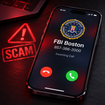
If your phone rings and the screen shows the FBI's real Boston office number, you'd probably answer. That's exactly what scammers are counting on.[1]
The FBI's Boston Division says criminals have found a way to disguise their caller ID so it displays the office's actual main line, then use that false sense of legitimacy to push people into handing over money or personal information.[2] The bureau issued a public warning about the scheme on November 25.
It starts with a phone call from someone posing as a financial institution representative, according to the FBI. The caller tells the victim their personal information was used to open an account to buy illegal firearms.
From there, the victim gets transferred to someone claiming to be an FBI special agent "investigating" the fraud. That person encourages the victim to verify the phone number, and then the call mysteriously disconnects.
Shortly after, the victim's phone rings again. This time it appears to be a call from FBI Boston's actual main number, 857-386-2000. The person on the line gives a fake name and badge number, then might tell the victim to move the conversation to an encrypted messaging app.
Benjamin Headley, assistant vice president and investigations manager at Washington Trust, told NBC 10 that the request to switch apps is one of the biggest red flags in the entire scheme. Moving the conversation off a traditional phone line can make it harder for a victim's family member or bank to overhear what's happening and intervene.
The bureau says it will never call or email private citizens to demand payment, threaten arrest, request personal or sensitive information, or ask them to communicate through an encrypted application.
It also says it will never request payment through prepaid cards, wire transfers, or cryptocurrency ATMs, ask victims to liquidate assets into cash or buy precious metals, or ask anyone to use their own money to "catch a criminal."
"Scammers are utilizing fear, urgency, and increasingly sophisticated tactics, including spoofing trusted phone numbers, to push people into acting before they can think it through," said Ted E. Docks, special agent in charge of the FBI's Boston Division. "If you get an unexpected call from someone claiming to be the FBI or any law enforcement agency, stop. Hang up. Then verify the caller by contacting the organization directly using a number you found yourself."
Headley offered similar advice: "Hang up the phone, look up the phone number for the local field office on their website, call them directly."
Government impersonation scams cost Americans more than $797 million in 2025 alone, with 32,424 victims reporting incidents to the FBI.
In Massachusetts, Maine, New Hampshire and Rhode Island, victims reported nearly $29 million in losses that year. Massachusetts accounted for more than $24.5 million of those losses.
The problem has continued into 2026. According to a September alert from the FBI's Internet Crime Complaint Center, the agency received nearly 61,000 complaints involving government or law enforcement impersonation scams between January 2025 and July 2026, with losses exceeding $1.6 billion.
Caller ID spoofing lets criminals disguise their phone numbers so incoming calls appear to come from a trusted organization. Even if you recognize the number on your screen, you could still be speaking to a scammer.
While blocking unwanted calls can help reduce your exposure to phone scams, you shouldn't rely on your phone's spam detection features to authenticate callers.
Criminals also impersonate the FBI through email, sometimes using official agency seals and photographs of senior officials to make their messages appear legitimate. As with other phishing scams, an official-looking message doesn't guarantee that the sender is who they claim to be.
If you receive an unexpected call from someone claiming to be with the FBI or any law enforcement agency, hang up. Then verify the caller by looking up the organization's number yourself, rather than using any number the caller gives you. For FBI Boston specifically, that published number is 857-386-2000, and you can ask to be connected directly to confirm whether an employee actually contacted you.
If you think you've already been targeted:

 ID theft protection that monitors your SSN, bank accounts, credit cards, and brokerage and retirement accounts for suspicious activity
Every plan includes the full feature set, so no additional cost to unlock monitoring, insurance, or restoration
Bundles data removal with identity theft protection, antivirus, VPN, and a password manager in one subscription