36% of Americans Have Secretly Logged Into a Partner's Account [Survey]
All About Cookies surveyed U.S. adults about password sharing between romantic partners. We found which passwords couples share most often, how quickly they share them, how often that access gets used without a partner's knowledge, and more.
We receive compensation from the products and services mentioned in
this story, but the opinions are the
author's own. Compensation may impact where offers appear. We have not included all available products or offers.
Learn more about
how we make money
and
our editorial policies.
Advertiser Disclosure
All About Cookies is an independent, advertising-supported website. Some of the offers that appear on this
site are from third-party advertisers from which All About Cookies receives compensation. This compensation
may impact how and where products appear on this site (including, for example, the order in which they
appear).
All About Cookies does not include all financial or credit offers that might be available to consumers nor
do
we include all companies or all available products. Information is accurate as of the publishing date and
has
not been provided or endorsed by the advertiser.
Close
Editorial Policy
The All About Cookies editorial team strives to provide accurate, in-depth information and reviews to help
you, our reader, make online privacy decisions with confidence. Here's what you can expect from us:
All About Cookies makes money when you click the links on our site to some of the products and offers that
we mention. These partnerships do not influence our opinions or recommendations. Read more about how we
make money.
Partners are not able to review or request changes to our content except for compliance reasons.
We aim to make sure everything on our site is up-to-date and accurate as of the publishing date, but we
cannot guarantee we haven't missed something. It's your responsibility to double-check all information
before making any decision. If you spot something that looks wrong, please let us know.
Close
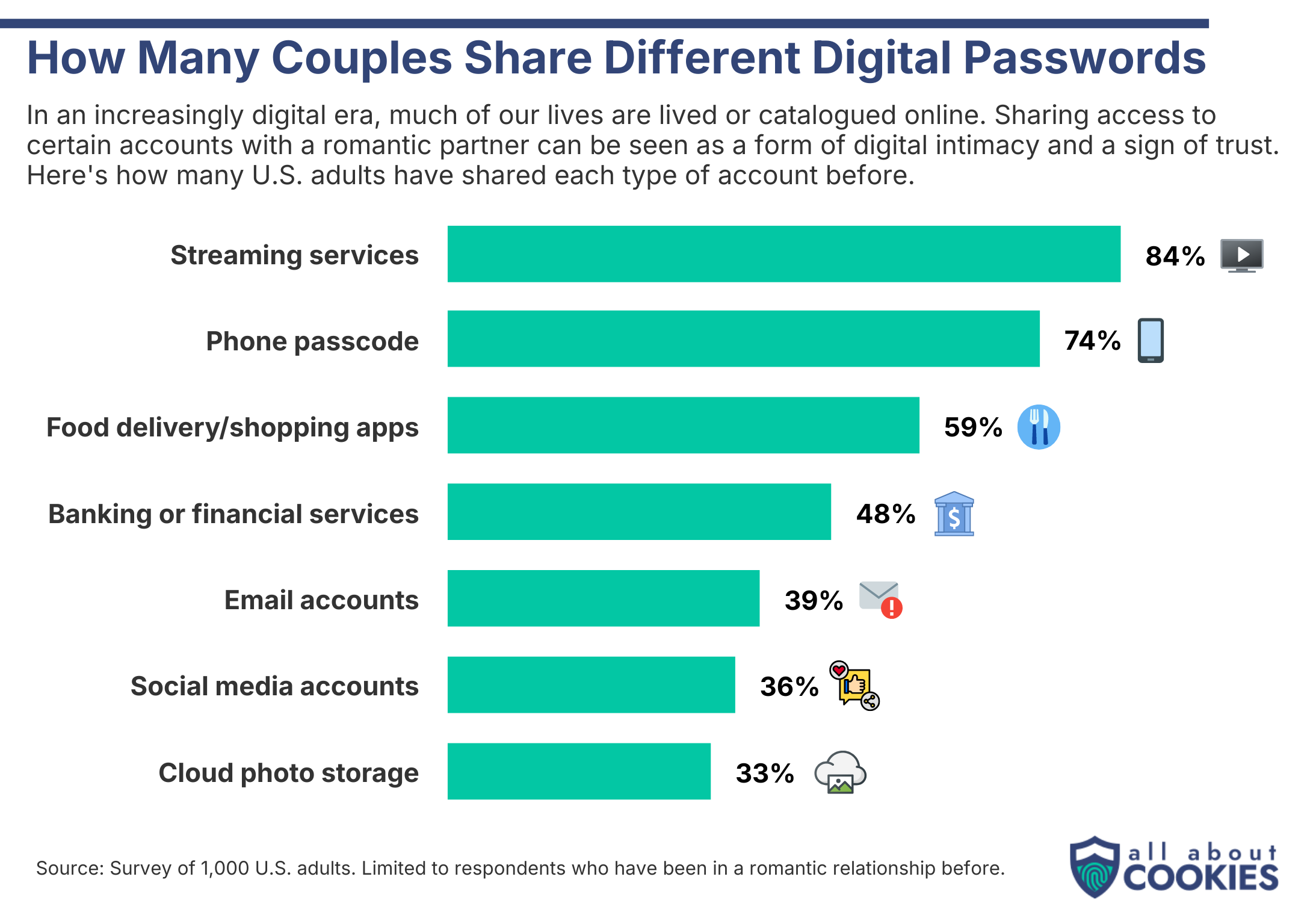
Being in a romantic relationship often involves sharing things with your significant other. Shared interests and hobbies can spark a relationship, while committed couples share living spaces and finances. Love in the age of streaming also means that many couples are sharing digital passwords with one another. In fact, 84% of people who’ve been in a relationship have shared a streaming login with a partner.
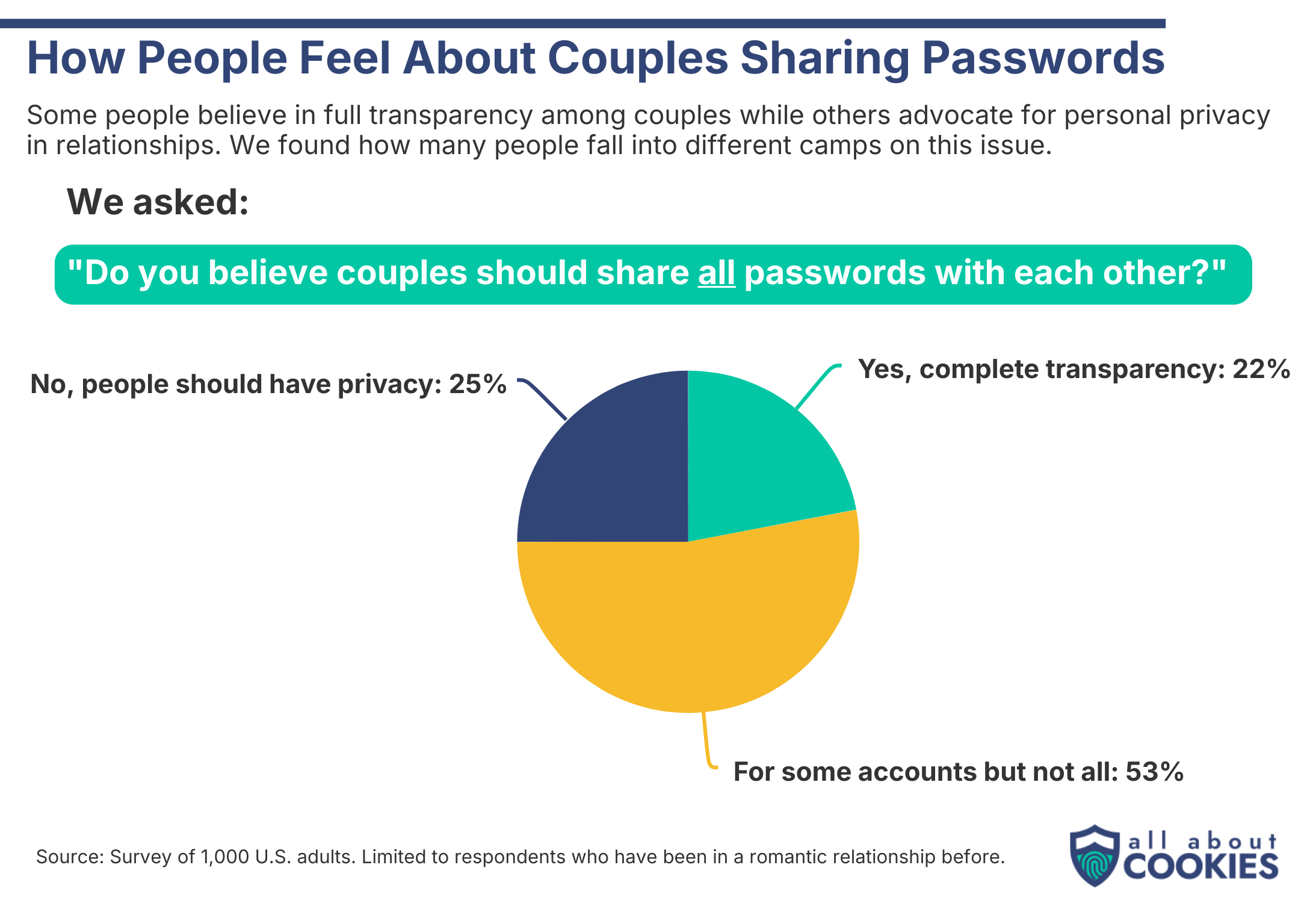
But sharing a Netflix login is one thing. Handing over the keys to your entire digital life is another, and most people draw a line somewhere. Three in four (75%) believe couples should share at least some of their passwords, but only about one in five think they should share everything.
To find out how far password sharing goes, All About Cookies surveyed 1,000 U.S. adults about which accounts couples share, how fast they hand over login details, what happens when curiosity or suspicion sets in, and more.
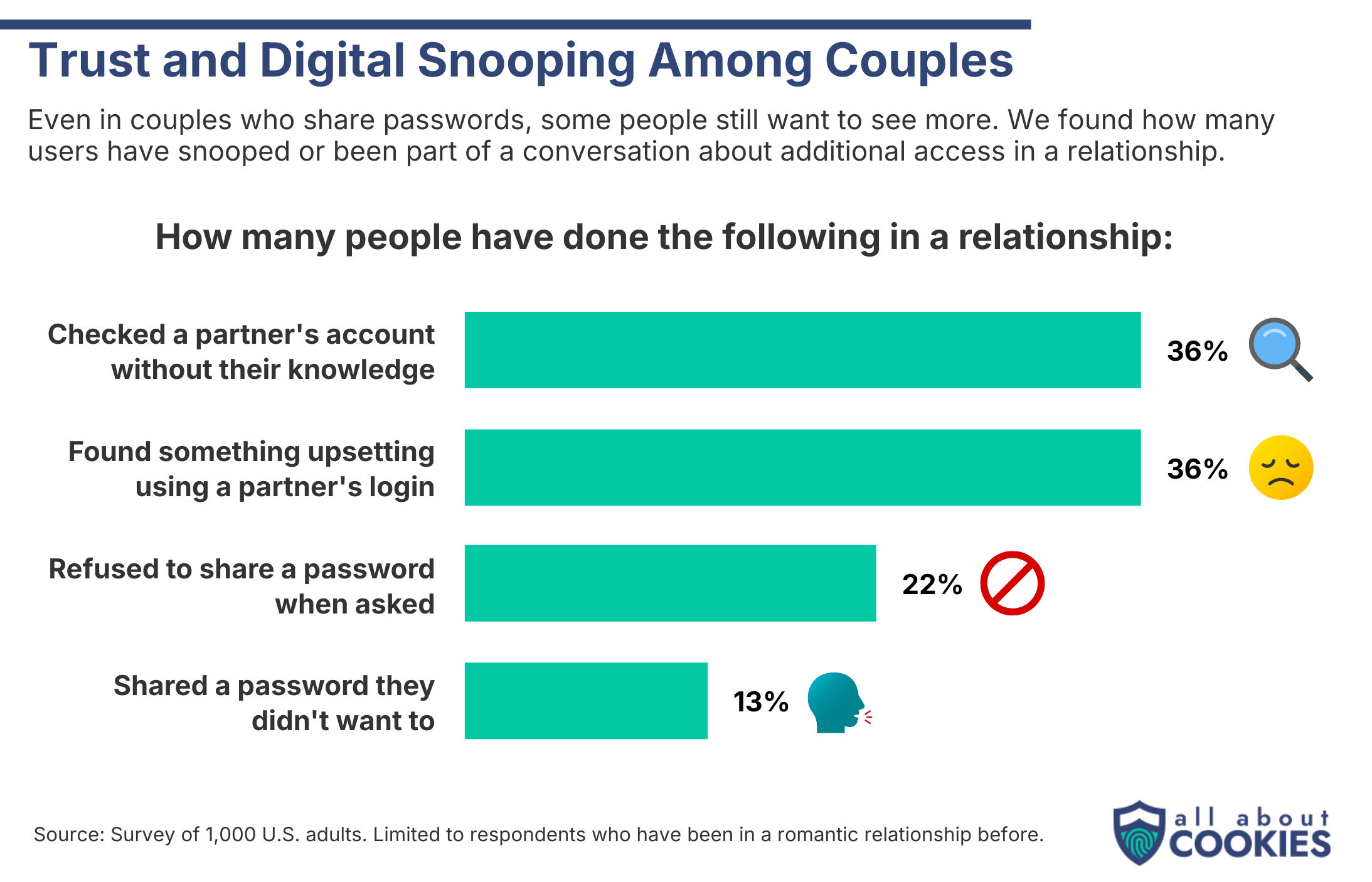
More than a third of Americans (36%) have used a password they weren’t supposed to have to secretly check a partner’s account or messages.
Just as many (36%) have discovered something upsetting or concerning by going through a partner’s or ex’s account.
When asked for a password they didn’t want to share, 13% gave in anyway, while 22% held firm and said no.
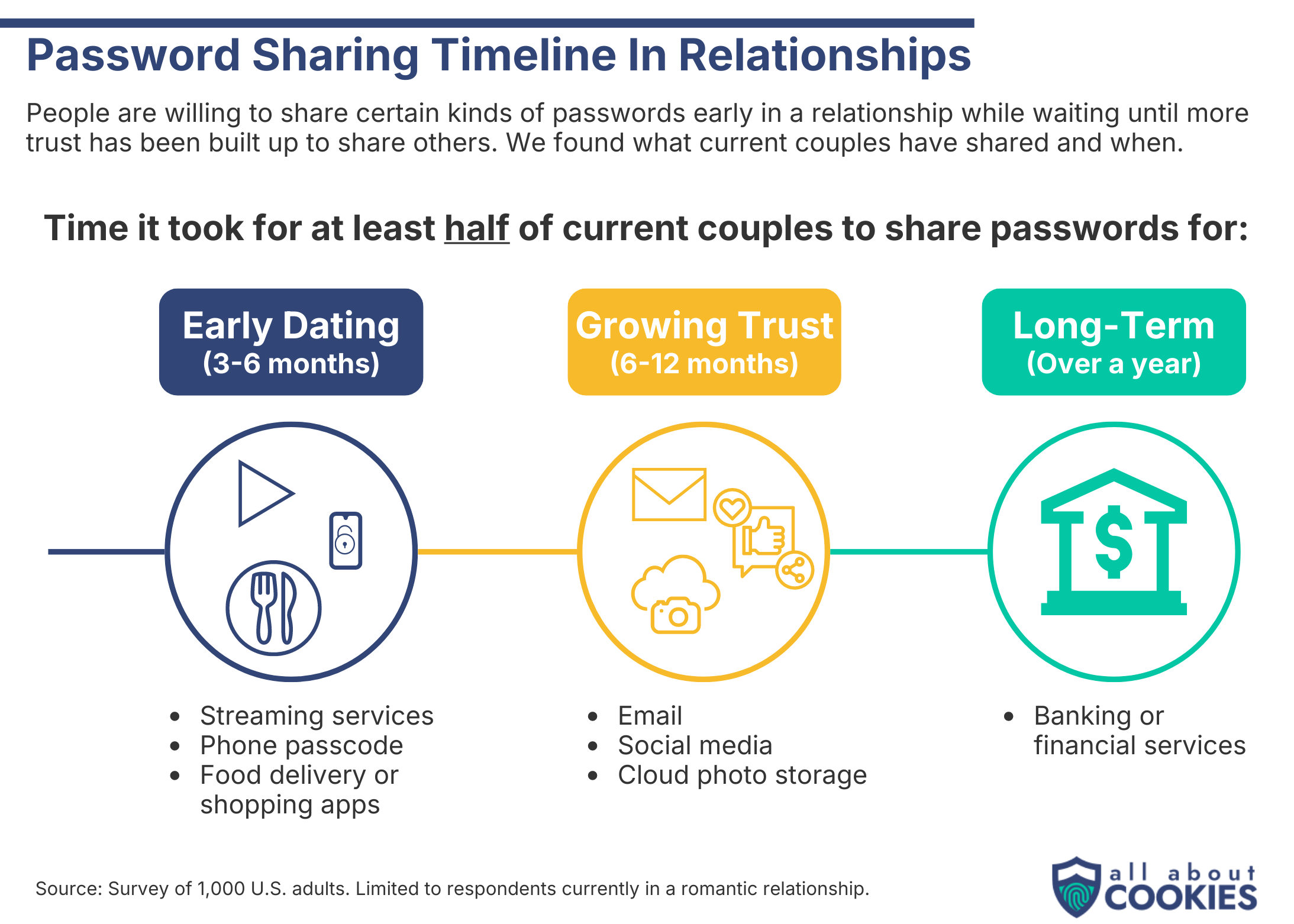
Streaming passwords get shared almost immediately, but couples wait far longer to hand over banking logins: 62% say it took more than a year.
The passwords couples are most (and least) likely to share
Most people have dozens of accounts for different apps and services that they use regularly, and many people find that it can be convenient and cost-effective to share login information and credentials for different accounts with their significant other.
The most commonly shared passwords in general are for streaming services, so it isn’t surprising that couples also find those logins easiest to hand over. 84% of respondents say they have shared a password for a streaming platform with a partner before, the highest share rate of any account type. There are two other types of passwords that more than half of couples share, as nearly three-quarters (74%) tell their partner the passcode to unlock their phone and 59% share food delivery or shopping app passwords.
When it comes to more personal accounts, password sharing rates drop. Fewer than half have shared banking logins (48%), and even fewer have shared access to their email (39%), social media (36%), or cloud photo storage (33%). These are the accounts that hold money, private messages, and personal photos, so it makes sense that people guard them more closely than a shared streaming queue, even from romantic partners.
How long does it take couples to start sharing passwords?
Most couples don't wait long to share some their passwords, though things shared in the early stages tend to be relatively low stakes, while passwords for more personal and important accounts are kept secure until the relationship has developed much farther.
How long it took people to share different kinds of passwords with their current partner
Password type
Less than a month
1-3 months
3-6 months
6-12 months
More than a year
Streaming services:
25%
18%
19%
15%
24%
Food delivery or shopping apps:
24%
17 %
19%
15%
26%
Cloud photo storage:
17%
11%
17%
15%
40%
Phone passcode:
16%
17%
22%
15%
29%
Social media accounts:
15%
14%
17%
22%
32%
Email accounts:
13%
9%
13%
19%
45%
Banking or financial services:
11%
5%
9%
14%
62%
Any kind of digital password at all:
16%
18%
22%
15%
29%
Streaming service passwords are shared the quickest, with 62% of couples sharing them within 6 months of dating, including one-in-four who shared streaming access with one another in their first month together. On the other end of the spectrum, 62% of couples waited more than a year to share login info for banking or financial services accounts. This shows that even among people in relationships, it takes an understandably long time to build up enough trust to share something as important as access to financial accounts and information.
Should couples share all their passwords?
People in relationships will eventually have to tackle the question of how much of their lives to share with their partner, including passwords.
More than a fifth of respondents (22%) say they believe in full transparency and sharing every single password with their partner. A quarter of people take the opposite position, advocating for privacy even among couples. The remaining 53% of people fall somewhere in between, saying that couples should share certain passwords with one another while keeping others to themselves.
6% of people say they have an ex who definitely knows a password that they still use, and an additional 12% think it’s possible but aren’t sure
Shared passwords can sometimes outlast the relationship, for better or worse. Among people with an ex, 6% say they have a former partner who definitely knows a login or password that they still use, while another 12% say it’s a possibility.
A good way to keep yourself safe even if a former partner knows one of your passwords is to turn on two-factor authentication, making it so an old password alone isn't enough to get in.
How often do couples snoop, hide secrets, or refuse to share passwords?
Shared access doesn't always stay above board. Sometimes people in relationships want increased transparency or have suspicions about their partner that lead them to engage in digital snooping.
More than a third of Americans who've been in a relationship (36%) have checked a partner's account or messages without their knowledge, using a password the partner didn't know they had. The same share have discovered something upsetting or concerning through a partner's or ex's login.
22% of people say a romantic partner has asked them to share a password, but they refused to divulge it, while 13% were asked and shared even though they didn’t want to. All told, that means that more than a third of people have been pushed by a partner to share a password they would have preferred to keep to themselves before.
How much do partners trust each other with password sharing?
Trusting your significant other with your passwords can be seen as a sign of digital intimacy and for most people currently in a relationship, trust levels with their partner are high.
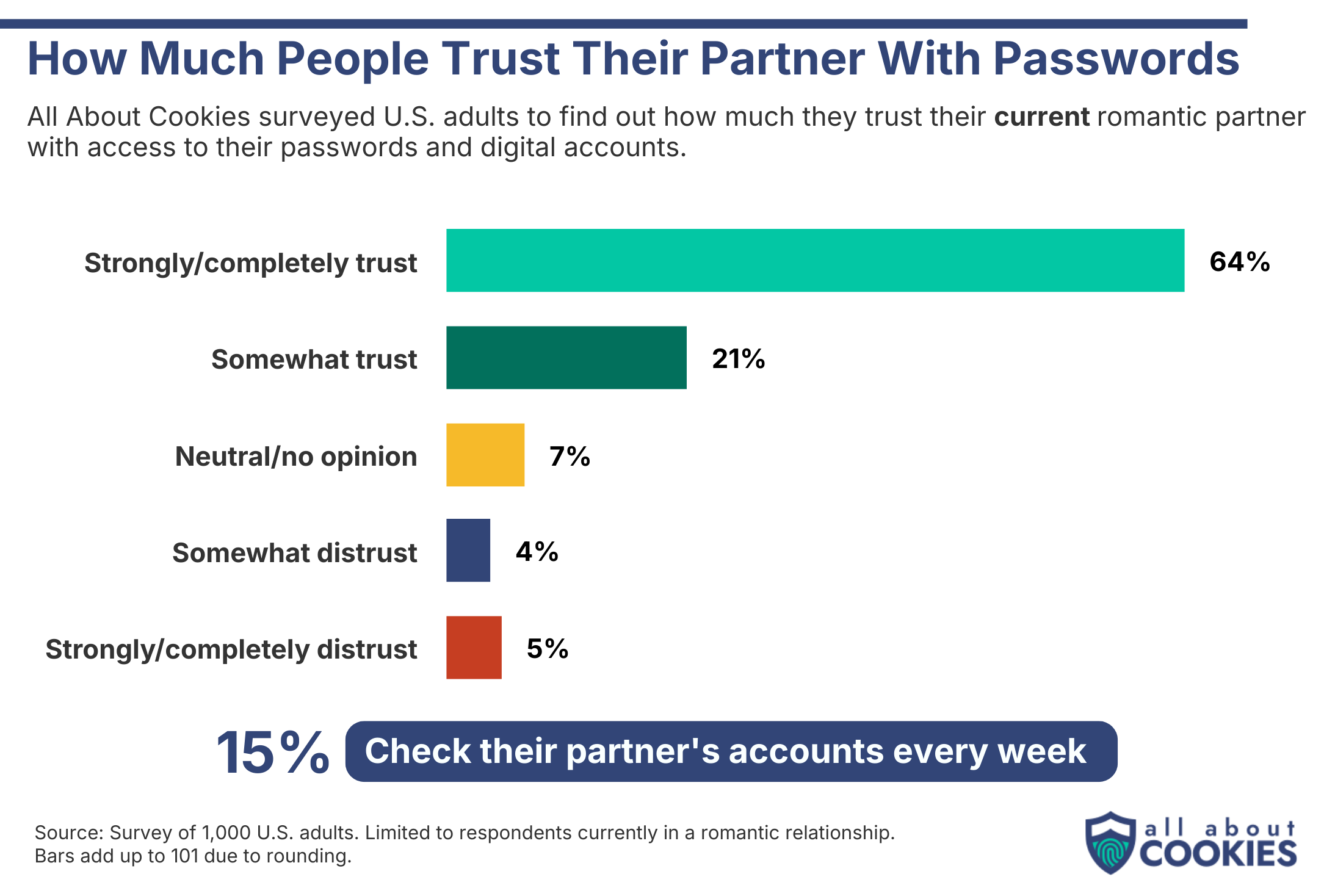
Nearly two-thirds of people in a relationship (64%) say they strongly or completely trust their significant other with their passwords, while an additional 21% somewhat trust their romantic partner. All told, that means 85% of people have positive trust in their partner when it comes to passwords. 7% have no opinion either way, while 9% actually distrust their significant other with passwords.
Speaking of distrust, we also found that 15% of people check their partner’s digital accounts every single week. 10% do so with their partner’s permission, while half as many (5%) check their partner’s accounts every week without permission to do so. This shows how important it is to be sure about what you want to share with a romantic partner, since you can never be sure how they will use it.
How to protect your privacy when sharing passwords with a partner
With trust playing such a big role in how couples handle passwords, a few precautions can help you stay in control of what you share, without exposing more than you intend to.
Consider a password manager instead of texting passwords back and forth. Many now offer shared vaults built for exactly this, letting you control what's shared without handing over your entire password list. Check out the best password managers.
Change your passwords following a breakup. It is always better to be safe than sorry when it comes to the end of a relationship, and that includes passwords you may have shared with your ex. Change passwords using top tips for creating strong passwords to keep your former partner out of important accounts.
If you suspect something beyond normal password sharing, antispyware software can help. It's built to detect and remove monitoring tools a partner or ex might have installed without your knowledge. See our picks for the best antispyware software.
Methodology
All About Cookies surveyed 1,000 U.S. adults in September 2026. Responses were limited to people who indicated they have been in at least one romantic relationship in their lives.
#1 Password Vault for Seamless Data Security
4.9
AllAboutCookies writers and editors score products based on a number of objective features as well as our expert editorial assessment. Our partners do not influence how we rate products.
Steph Trejos is a Certified Anti-Money Laundering Specialist (CAMS), a credential that reflects deep expertise in financial crime, fraud patterns, and cyber threats. As a Senior Product Testing Editor at All About Cookies, she has personally evaluated over 200 digital security products and brings that forensic rigor to every review she oversees. Before joining AAC, she produced publications on financial crime and cyber threats at ACAMS.